
Dimmit Parole Versus Probation
Parole is conditional release from TDCJ physical custody while the state sentence continues. Mandatory supervision is another supervised release route under Texas law. The TDCJ Parole Division supervises both, but the Texas Board of Pardons and Paroles decides parole and revocation matters. A parole entry therefore supports that prison confinement ended. It does not show that the sentence was discharged.
Probation is imposed by a court instead of being a prison-release decision. Texas statutes and agencies often call it community supervision. The sentencing court and the relevant Community Supervision and Corrections Department, or CSCD, are the right sources. Texas has no public statewide probationer name search comparable to the TDCJ offender locator, so a Dimmit County judgment or docket is the practical starting point.
| Feature | Parole or mandatory supervision | Probation |
|---|---|---|
| Source | TDCJ sentence and Board action | Sentencing-court judgment |
| Supervisor | TDCJ Parole Division | Relevant local CSCD |
| Public check | TDCJ record and parole inquiry | Court docket, clerk, and CSCD |
| End point | Discharge or other lawful sentence end | Court-recognized completion or discharge |
- Parole
- Release from prison to serve the remaining state sentence under conditions.
- Probation
- A court-ordered form of community supervision, often imposed instead of prison confinement.
- Discharge
- The end of the displayed sentence or supervision obligation.
- Absconder
- A supervised person who fails to report and cannot be located by the supervising authority.
Verify Dimmit Post-Release Supervision
Begin with identity, not a date alone. TDCJ accepts a name, seven-digit TDCJ number, or State Identification number, and its detail fields may show a parole or mandatory-release date, supervision status, office, maximum expiration, or discharge data. If the person was sentenced only in a Dimmit County court, use the correct clerk to obtain the judgment and identify the CSCD. The County Clerk handles county criminal matters, while the District Clerk is the contact for felony and district files.
- Confirm the full name and, when available, date of birth, cause number, TDCJ number, or SID.
- Search the TDCJ offender locator for a state-prison or parole record. Read current status before interpreting any date.
- Look for parole or mandatory-release date, supervising office, maximum expiration, and discharge. A current unit means the person remains incarcerated.
- For probation, obtain the sentencing judgment and docket from the Dimmit clerk with jurisdiction. Ask which CSCD supervises the case.
- If the official fields are incomplete, call the Parole Status Line or make a focused request for the release certificate, discharge certificate, and supervision status.
Use the Dimmit County released-inmate search path when the prior custodian is unknown. A county jail departure can also be a transfer to TDCJ, another county, federal custody, or ICE. None of those events establishes community supervision.
Dimmit Supervision Contact Routes
The research did not identify a verified Dimmit County government reentry office or publish a single local office as the supervisor for every probation case. Court records must identify the proper CSCD. For TDCJ parole, the public record may name the supervising office or officer, and the state inquiry route can resolve an unclear result.
844-512-0461
Official parole contact routes
Dimmit County District Clerk
212 North Fourth Street, Suite 202
Carrizo Springs, TX 78834
830-876-4243, extensions 1211-1214
Monday-Friday, 8 a.m.-noon and 1-5 p.m.
A clerk can explain which office holds a court file but cannot convert a projected date into proof of release. Ask for the judgment, modifications, revocation entries, and any order that ends or changes community supervision.
Dimmit Violations and Absconders
Conditions are rules imposed by the Board, Parole Division, or sentencing court. A violation can prompt added controls, a warrant, revocation proceedings, or a return to custody, but the response depends on the controlling order and facts. Do not infer a warrant from a missed appointment or stale online entry. TDCJ policy identifies warrant number and date as public fields subject to required redactions, so an official inquiry is stronger than rumor.
Fuginet, TDCJ's detailed fugitive system, is restricted to authorized criminal-justice users. It is not a public Dimmit County lookup. Public users can rely on TDCJ parole inquiry routes, public warrant fields, and the specialized sex-offender absconder search only when that registry law applies. A registry search is not a general parole or probation search. If sources conflict, preserve the conflict and contact the office closest to the event.
Dimmit Supervision Through Discharge
The state sequence is eligibility, review, approval, scheduling, release under supervision, and discharge. Each stage means something different. Eligibility opens consideration. Approval is favorable Board action. Scheduling reflects later processing. Release under supervision ends physical prison confinement, while discharge ends the displayed sentence obligation. Program-conditioned approval, residence approval, a release certificate, record audit, or a detainer can still stand between a favorable vote and actual departure.
For exact proof, request the release or discharge certificate and the Public Information Display Screen. TDCJ's general email service can provide incarceration history and projected-date information, but it does not supply photographs. Formal public-information routes can seek the certificate, final parole or mandatory-supervision decision, current office and status, and TDCJ-CID photograph subject to redaction.
Dimmit Parole Review Records
Texas routine parole review is file voting, not a formal public candidate hearing. The official panel-review FAQ explains that members review and vote files individually. TDCJ identifies initial cases before eligibility, an institutional parole officer interviews the person, and a three-member panel considers the record. Two matching votes decide an ordinary case. There is no honest inmate-by-inmate hearing calendar to publish.
The Board meeting minutes document administrative meetings, not appointments for release candidates. Read the individual record and the official vote-code key instead. FI codes indicate forms of favorable action, some conditioned on treatment or other steps. NR is a denial with later review timing where applicable. SA and DMS have distinct official meanings. Always use the live code page because definitions can change.
The official panel FAQ is shown below as evidence of the file-review process.
View the Texas parole panel FAQ before interpreting a claimed hearing date.
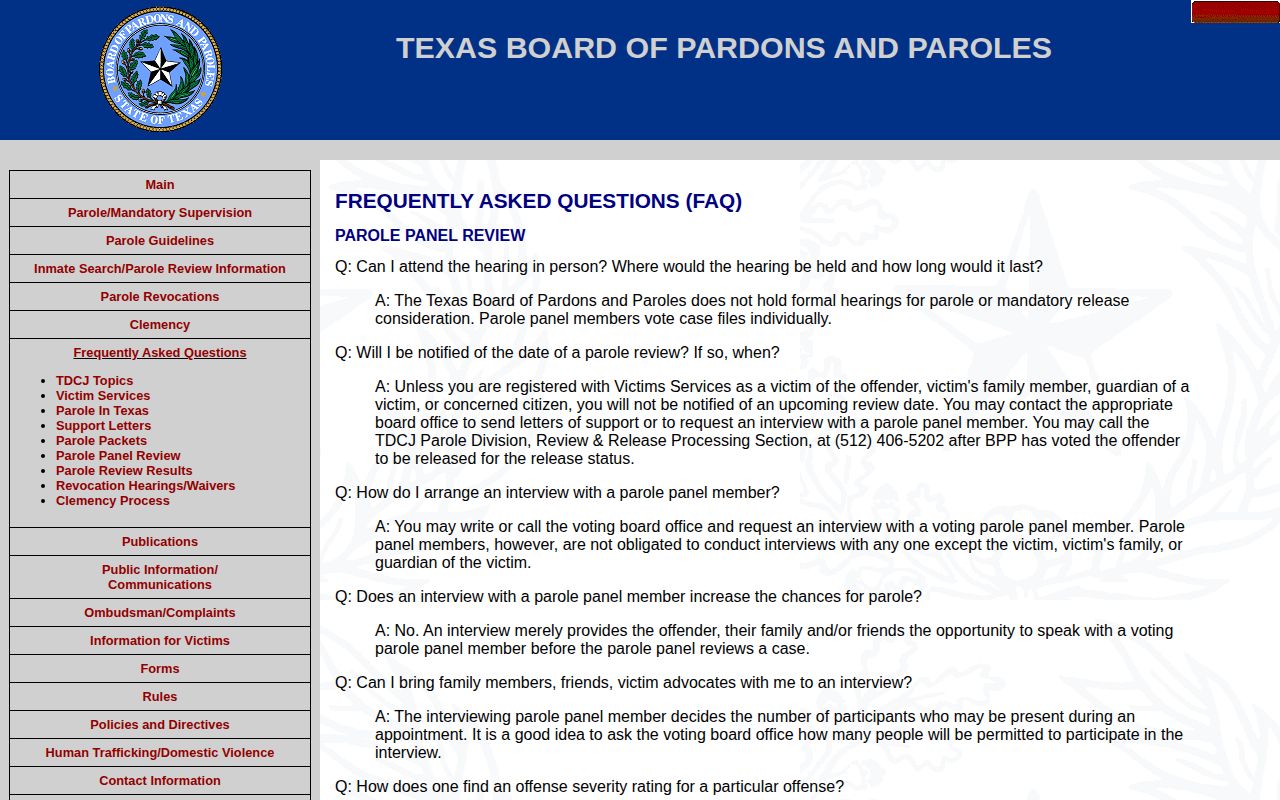
The captured page illustrates the statewide review framework; it is not a calendar or a status record for a named Dimmit County person.
Dimmit Release ID and Property
No official Dimmit County source reviewed on August 2, 2026 published a release-day identification or property-return procedure. Call the Dimmit County Jail at 830-876-3508 before travel and ask what record or identification is required for the specific issue. Do not assume an intake or oversight document establishes the release process.
For a lost Texas license or identification card, use the Texas DPS replacement-ID route. A replacement card does not alter supervision status. Keep identity-document questions separate from corrections records, and direct any record error to the agency that created the source entry.
Dimmit Public Supervision Records
TDCJ policy treats supervising-office and officer data, supervision status, parole or mandatory-release and discharge dates, warrant information, conviction and sentence data, and a TDCJ-CID photograph as public subject to required redactions. That makes a focused inquiry more reliable than guessing from a projected release date. Ask for existing records and identify the person with enough detail to avoid a name-only mismatch.
A practical request names the release certificate, discharge certificate, final Board decision or minute, actual release and discharge dates, current supervision status and office, and Public Information Display Screen. The agency may redact protected data. A partial disclosure is not proof of current custody, and a missing online result does not erase a prior TDCJ episode.